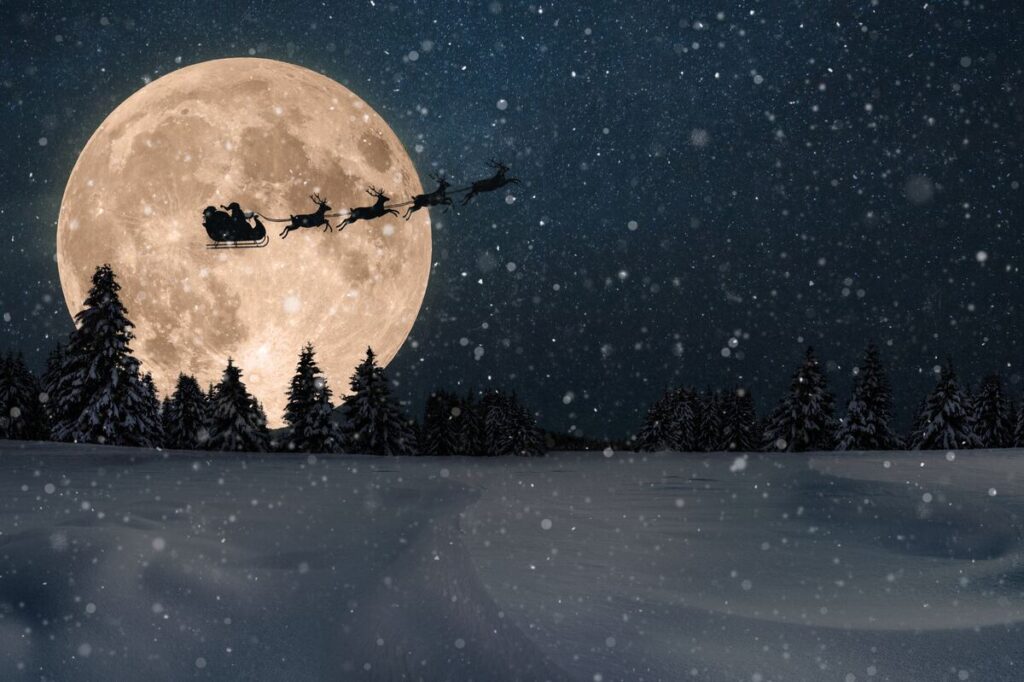
Santa Claus is coming to town!

Santa charged with breaking and entering the Mills home!
The man known as St. Nicholas has been arrested tonight on the account of breaking and entering the private residence of the Mill family home. Suspect was seen placing suspicious colourful boxes under the Christmas tree while stealing food including ‘carrots, cookies and milk’.
“We heard something land on the roof and woke up in the middle of the night, when peeking downstairs we saw a white bearded man eating our Christmas cookies!”
The family are pressing charges on the man and he is now being held for questioning including his possession of suspicious boxes in a large red bag. He pleads innocent to any of the shenanigan’s performed tonight.
SANTA ESCAPES POLICE CUSTODY
The disappearance leads to a man in the sky! The police returned to St. Nicholas’s cell at the stroke of midnight only to find he had vanished without a trace! only a note was left in his place…
“You mills will not ruin the spirit of Christmas, BAHUMBUG and Merry Christmas!”
On going investigation will develop further within the following weeks.
The Christmas mythology surrounding Santa Claus is opaque. We can trace earliest mentions of the icon back to 4th Century Myra, by the name of St. Nicholas. Our would-be Father Christmas was a respected community figure who dropped dowries down chimneys and worked as a local bishop.
Beyond St. Nicholas’ initial foray into philanthropy, his brand took a leap in 1087 when his relics were taken to Italy. However, it wasn’t until the 17th century that St. Nicholas would become one of the most popular figures in Christmas mythology; in the Netherlands he would be given the moniker of Sinterklaas, while Ben Jonson fast-tracked his fatherly status in popular culture with “Christmas, His Masque” at the Globe Theatre, London. The reimagined “Santa Claus” steadily built on the hype before establishing his global gift-giving operation in the 20th century.
Santa Claus’ motives are infamously vague. We can assume he’s independently wealthy by the scale of his business and its unsustainable overheads. He has, of course, participated in a dearth of brand deals across the year—most notably the Coca Cola Santa ad of 1995—but this has done little to dispel the mystery surrounding his public persona. While an odd blend of conservative and socialist values come into play, there is no simple way to know if his reasons for coming to town.
5 reasons Santa Claus may not be coming to town
We can assess the likelihood of Santa Claus’ coming by examining long-term trends in global culture and the North Pole’s business strategy. As such, we’ve compiled five reasons why Santa Claus may struggle to meet expectations per annum. We will also outline grounds for his shirking of responsibility altogether.
1. Waning belief
A theory widely popularized through Jon Favreau’s 2003 study on St. Nicholas, “Elf“, is the sleigh being powered by Christmas cheer. According to a recent article by YouGov, only 65% of US parents say their children will hang up a stocking this year, and 45% will leave out cookies and milk. First up, this is just bad manners. Add that only 58% of parents have children that believe in Santa, and it’s clear that waning cheer levels will put a strain on sleigh mechanics. Santa does benefit from varied timezones. But downward trends in holiday cheer will certainly impact operations.

2. Changes in culture
Santa Claus is a public figure with global impact. The world population is more conscious than ever that he occupies this position undemocratically. As a remnant of feudal culture in a world that’s evermore republican, Santa Claus finds his position in modern society weaker than ever. It’s unsurpising to see reports that the Grotto is keeping a close eye on developments inside Buckingham Palace, with Mrs. Claus being a big fan of Netflix documentary “Harry & Meghan“. And it’s not just public resentment that’s on the up. While crime rates have regularly dropped over the last few decades, social media is fuelling a perception gap whereby the public believe the opposite to be true. We don’t believe Santa Claus has a reliable big data strategy, so you can expect the naughty list will be larger than ever in 2024.
3. Limited talent pools
Santa’s supply chain and talent recruitment is limited. Contracting the free labor of elves is more bureaucratic than ever, even if they are willing. Furthermore, public unrest about Santa’s use of reindeer has risen since the first radio-airing of “Rudolph the Red-Nosed Reindeer” in 1949—only two years after courts ruled that organisations campaigning to end animal experiments suffered could no longer have charitable status. Take into account the continued digitalization of HR trends and a growing skill gap with AI, and you can expect innovation strategies are top of the agenda at the North Pole. This was, however, somewhat inevitable when choosing to build a workforce around mythical creatures and hoofed ruminants.

4. Population growth
Rising population levels mean overextended resources. The global population has increased by over 200% in the last 100 years alone. While only 31.6% are Christian families and a still smaller portion are of gift-receiving age, the North Pole is barely getting by. Inflation adds further pressure, with global prices being some 154 times higher in 2024 than in 1900. Procedures at the Grotto are feeling the pinch as its woefully monolithic economy bends under the weight of expectation.
5. Unrest behind closed doors
PR at the North Pole is something of a closed shop. Still functioning on an anticuated postal system, the Grotto’s communications department is renowned for inconsistent and often cryptic messaging. Factor in Santa’s tendency to send lookalikes to public appearances at malls and schools, and you’d be forgiven for believing reports that he’s fallen into paranoid isolation. This may be a response to continued competition from alternate magical gift givers such as the three kings, who dominate a number of dedicated Christian markets. Whatever the reasoning, one thing is clear: Santa is keeping his cards close to his chest.
Debunking Christmas myths around Santa Claus: proof operations to continue as normal
We still believe Santa Claus will come to town despite these varying challenges. Christmas myths pop up every year about his dedication to the cause—all, as yet, have been unfounded.
New tools like Generative AI will no doubt streamline internal processes for the jolly old fellow. He’s also free to borrow from innovative energy practices to alleviate strain on magical resorces. In fact, it would be foolish to measure his resources against our own mortal metrics. The truth is we have very little understanding of magic. While we can hope to incorporate magical practices into our own by 2050, the R&D simply isn’t there for us yet. Santa continues to safeguard said information against malpractice.
Whatever motivates Santa Claus, and whatever his methods, we can only cross our fingers in hope of his return. We, of course, continue to believe, as we always have, and we will continue to be very good, as we have all year.
Date: 25th December 2025




Post Comment